
Introduction To Spiritual CounterfeitsBy William Handschumacher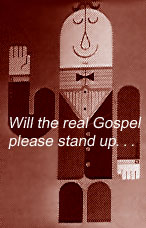 Please review Clarifying Our Definition Of "Counterfeit" before reading this article.
Younger visitors may wonder about the picture on the left. Some recognize it as the logo of an early television program. Between 1956 and 1967 CBS produced a prime-time game show entitled "To Tell the Truth". My parents regularly watched this show. The theme carries an important message about the nature of counterfeits. The show consisted of the host, Bud Collyer, a panel of four Hollywood celebrities and a set of three mystery contestants. Broadcast time only allowed 2 or 3 sets of challengers to appear. The object of the game was simple--at least on the surface. All three challengers introduced themselves as the same individual, using the same name. The host read a statement describing the life and experiences of the person who all the contestants claimed to be. The panel of celebrities were allowed to question the three contestants to determine which one was telling the truth and which two were lying. At the end each celebrity voted for whom he or she thought was the person the host described in his opening statement. Wrong guesses credited money to all three contestants, who split the winnings equally. The largest sum of money was awarded when the three contestants "stumped the panel" (no one guessed correctly). It was in the contestants best interests to fool the panel. The famous line at the end of each round was, "Will the real [person's name] please stand up!" Some identities were discovered quickly. Yet, some clever contestants would "stump the panel". Spiritual counterfeits are much the same. However, in the real world being "stumped" by a religious counterfeit can be "spiritually" expensive--and it can cause you to lose the "game of life" entirely. We've used this same illustration in other commentaries on this website because it perfectly describes what beleivers face in the Christian Church. I'm hesitant to discuss religious counterfeits for fear of dissuading the reader from learning about Jesus. Yet, something must be said about the dangerous influences that exist within institutional Christianity. The subject of spiritual counterfeits can be over-whelming. Christianity has existed for nearly 2000 years. During that time, our enemy threw every imaginable doctrine of error into the arena of Biblical discussion in order to frustrate the efforts of those who seek the truth. The current spiritual darkness is the result of overwhelming religious misinformation and the scarcity of truth. Yet, God promised that the generation of Christ's return would be characterized by "delusion" (2 Thess. 2:11-12). As you learn more about the Bible you discover various religious teachings, which are in opposition to it. If you decide to confront the subject of false teachings you engage in the endless task of defense that could raise more questions than it answers. Some early church writers, such as Tertullian, spent their entire life writing books, which refuted Gnosticism (considered "the dreadful sum of all heresies"). Today, we face false teaching that come from a variety of sources. Those which originate from other so-called "Christian" groups are the most difficult to address. We not only need to be aware of the non-Christian heresies like Gnosticism --but also all the other wrong teachings, which are widely accepted as church doctrine. I choose to discuss subjects that every Christian should know about. Yet, part of spiritual maturity is learning to recognize falsehood on your own (Hebrews 5:14). The first obvious method for discerning falsehood is comparing the teaching with God's Word. However, you need to have a correct knowledge of the Word and its context in order for this to work. Most spiritual counterfeits hide behind a "skewed" interpretation of the Scriptures making any evaluation difficult. In the more advanced cases the Holy Spirit warns you about these things if you've trained yourself to recognize his voice. Unfortunately, most maturity will be gained the hard way through painful experiences. Writing about every false doctrine in the church is a time consuming task and will not be one of my goals. This website is geared toward exposing spiritual counterfeits because they keep us from experiencing the blessings of the Gospel--and may even cause a person to miss God's salvation entirely. Discussing counterfeits is vitally important because they directly affect a person's conception of God. If our conception of God is distorted we can trick ourselves into thinking everything is all right when we're actually out of fellowship with Him. Both Jesus and the early church taught about spiritual counterfeits in the context of the Gospel. Jesus gives us a picture of the seriousness of the situation in his parable of the "wheat and the tares" in Matthew 13:24-30... "Another parable put he forth unto them, saying, The kingdom of heaven is likened unto a man which sowed good seed in his field: But while men slept, his enemy came and sowed tares among the wheat, and went his way. But when the blade was sprung up, and brought forth fruit, then appeared the tares also. So the servants of the householder came and said unto him, Sir, didst not thou sow good seed in thy field? From whence then hath it tares? He said unto them, An enemy hath done this. The servants said unto him, Wilt thou then that we go and gather them up? But he said, Nay; lest while ye gather up the tares, ye root up also the wheat with them. Let both grow together until the harvest: and in the time of harvest I will say to the reapers, Gather ye together first the tares, and bind them in bundles to burn them: but gather the wheat into my barn." (KJV)Jesus' disciples asked him to explain this parable in greater detail. Jesus told them that the good seed are the children of the kingdom, the tares are the children of the wicked one, the enemy who sowed the tares is the devil, the harvest is the end of the world and the reapers are the angels. It's important to understand that spiritual counterfeits are just as much, if not more, "from the devil" as a godless and perverse lifestyle. Jesus states this fact during one of his "heated" confrontations with the religious counterfeits of his day--the Scribes and Pharisees in Matthew 23:15..."Woe unto you, scribes and Pharisees, hypocrites! for ye compass sea and land to make one proselyte, and when he is made, ye make him twofold more the child of hell than yourselves." (KJV)And again in John 8:44 Jesus had another verbal exchange with religious leaders when he said..."Ye are of your father the devil, and the lusts of your father ye will do. He was a murderer from the beginning, and abode not in the truth, because there is not truth in him. When he speaketh a lie, he speaketh of his own: for he is a liar, and the father of it." (KJV)Why am I saying all of this? People avoid the discussion of "counterfeits" for fear of infringing on "unity" and offending other believers. Many of us are constantly reminded that disrupting unity is sin because it violates "walking in love" with other Christians. Yet, it's the church's silence that contributes to the success of counterfeit Christianity--and Jesus was never silent on the subject of truth. Most Christians want peace at any cost--they just want to "get along" because they wrongly believe this is what Jesus taught. The confrontational aspect of Jesus' life is rarely discussed because the church wants to portray him as someone who practiced love and forgiveness wherever he went--and he did. Yet, when spiritual truth was in jeopardy Jesus took a strong stand to defend it. Jesus thought it more important to confront the religious distortions of His Father's character rather than compromise in the name of peace and unity. Also, Jesus shows us that religious leaders who propagate and defend the false religious system do not represent God. They only appear to. Their whole existence is but an illusion of godliness. This is dangerous and offensive territory. I consider some religious leaders "counterfeit" because they masquerade as servants of God while in reality they are enemies of the cross (II Corinthians 11:13-15, Philippians 3:16-18). They are "look-alikes". No Christian today should underestimate the ability of these counterfeit servants of God to "blend in". Most religious leaders (who Paul referred to as "enemies of the cross") do not know their true nature--which was the case above in John 8:44. They are sincere and committed to what they believe--and they believe they are doing God's work (John 16:1-3). There is another reason this subject is dangerous. It is possible to be a true believer in Christ, yet teach false religious doctrine out of ignorance. No one should take what is said here as a license to verbally attack any spiritual leader just because Jesus did so or because of anything published on this website. Seeing yourself as "defender of the faith" and lashing out at everyone who disagrees with you is not a Godly character trait. God has his own way of dealing with false religion and he'll use someone who walks in love, is mature in the faith and is fully instructed in his Word.To the untrained eye it's difficult to tell the difference between wheat and tares. However, it's clearly God's intention to leave the wheat and the tares alone until the harvest. Separating them early damages the wheat. For this reason, God will not permanently deal with false religion and spiritual counterfeits until the end of the age. Therefore, it is important to discover them in order to escape their trappings. Spiritual counterfeits are SERIOUS business and easily found within institutional, denominational and non-denominational Christianity. Many Christians follow seminary trained ministers thinking they are safe--this is NOT TRUE! Any time you engage in challenging people's beliefs, you find yourself making enemies rather than gaining friends. Let me explain why. The Gospel means "good news". However, there's another influence operating in the church that disguises itself as the Christian Gospel. This influence (a counterfeit) is called "religion." Religion and Christianity are two opposing ideologies. Yet, they appear as "look-alikes". The majority of Christians are taught that they are the same. Many people live under the dictates of religion while desiring the benefits of the Gospel--but God does not respect this choice. Religion is "The way that seemeth right unto a man but the end thereof is the ways of death (Proverbs 16:25)". Religion masquerades as a relationship with God, which acknowledges a "type" of personal faith, and is based in performance or some system of works usually associated with some kind of church or denominational affiliation. Religion misuses and twists Scripture to prove its declarations. It subtly places us in a position of "performing" as a means to gain God's acceptance. Christianity is a relationship with God based only on one's faith (trust) in Jesus Christ as the Son of God who permanently took their sins away. Christianity places us in a position of rest because Jesus has already performed every work necessary to secure salvation for us. Until we expose the counterfeit of religion and repent of it, the Gospel will have little benefit. Religion "short-circuits" the blessings of the Gospel. In America (and the world), Christianity has been made into a religion and few are aware of its dangerous deceptions. Religion acts like a type of "drug" that causes anger when it is challenged. Many bloody "religious" wars were fought down through history. The first murder in the Bible (the story of Cain and Abel) was caused by God's rejection of Cain's "religion" (Genesis 4). Religion refuses to surrender even when confronted, face to face, with the truth. Religion always persecutes authentic Christianity while declaring itself as the "true" faith. In the end, it will claim millions of unsuspecting victims. To the untrained ear, it's difficult to tell the difference because religion skillfully mixes both truth and falsehood in its teachings. The institutional "Christian" church has a massive infrastructure that propagates and defends this counterfeit. It carries many labels and names and it crosses all denominational lines. Jesus had to deal with religious persecution in His day and He promised the same for his followers. It was people who were motivated by religion that demanded the crucifixion of Jesus. They essentially took this action because they believed they were serving God. Jesus challenged and exposed their religious beliefs as being false, and this angered them. Today, the more dangerous forms of religious counterfeits are those who preach about Jesus and "appear" to support the things He taught. These groups also believe they are serving God--and they totally convince their followers of that fact. Today, everyone's opinion is treated as the truth. I look at thousands of different churches and see multitudes of people that believe all kinds of things that disagree with Scripture--each one believing they are right with God. It's not socially acceptable to point out error because everyone's right! Challenging wrong beliefs makes you a "mean" intolerant person. Insisting that church teachings adhere to the Word of God earns you the label of "divisive" or a "sower of discord" in some groups. Also, studies have shown that more than 90% of society make decisions based on emotions, rather than truth. This is especially true among Christians and it will have tragic consequences in the end. Christians usually fail to test themselves against the standard of God's Word to see if they're "in the faith". Instead, Christians trust their churches, church leaders and their "feelings" with this crucial responsibility. MANY will find out too late that their beliefs were wrong. My goal in raising these issues is not to shake anyone's faith. The objective is to get people to examine themselves as to whether they are truly "in the faith," as II Corinthians 13:5 commands. The apostle Paul said this because there were many false religious teachings in his time--and many were led astray. There are many more false religious teachings today--sincere church leaders with good intentions propagate most of these--and many are led astray. It takes courage and a willingness to overcome offense to obey Paul's admonition. "Rock of Offence" was born out of a burden to address some of these unpopular issues. Today we see a record number of Christians who have abandoned church attendance. Many church leaders label this act as "backsliding" or outright sin. I do not necessarily share this view. Jesus said in John 10: 1-5, "Verily, verily, I say unto you, He that entereth not by the door into the sheepfold, but climbeth up some other way, the same is a thief and a robber. But he that entereth in by the door is the shepherd of the sheep. To him the porter openeth; and the sheep hear his voice: and he calleth his own sheep by name, and leadeth them out. And when he putteth forth his own sheep, he goeth before them, and the sheep follow him: for they know his voice. And a stranger will they not follow, but will flee from him: for they know not the voice of strangers."When Christians stop following the religious "status quo" (some call them "Unchurched Christians"), we need to pay attention. A few may "fall away" from the faith, but most are not in that category. I've found that the reason Christians stop attending church is because they "don't hear the voice of Jesus the good shepherd" coming from the leadership. Or, they see God's Word violated and replaced with man's philosophy. For the casual observer, these things may appear as just excuses--but they're not. As Christians mature in their understanding of the spiritual world, they begin to realize the difference between the words of church leaders who use the Scriptures in their teachings--and following the voice of Jesus our shepherd. They are not necessarily the same thing! In the above Scripture, Jesus said, "...a stranger will they not follow, but will FLEE FROM HIM". A "stranger" can say all the right words, quote the Bible and stir your emotions with a wonderful sermon--but Jesus indicated that His sheep will still react to him as a stranger. In today's Christian culture, church leaders are always assumed to be right because of their training and education. So, when church members start to leave or become less active--it is automatically assumed that they are either backsliding, falling away or somehow in the wrong. Jesus approached the issue from the opposite direction. He said that when the sheep don't recognize His voice, they flee. The reaction of "His sheep" is the acid test--Not the declarations of the "leaders". I've discovered an important truth during the years I've known the Lord--God's sheep aren't dumb.Poisoned Milk
I Peter 2:1-2 tells us: "Wherefore laying aside all malice, and all guile, and hypocrisies, and envies, and all evil speakings, As newborn babes, desire the sincere milk of the word, that ye may grow thereby." (KJV)Peter tells us that the Word of God is like milk that helps us grow and mature as Christians. However, I've learned that those who serve it can poison the milk of God's Word. A nice big glass of cold, tasty milk is set before you--and it's a hot day. This glass of milk can be 99.5% pure--with the other .5% arsenic. Would you drink it? After all, it's "almost" 100% pure milk!Not all spiritual counterfeits are deadly, but some are lethal when you get a continual dosage. If a criminal wanted to kill his victim with arsenic, they could do it in a series of small doses. The poison builds up in the victim's body over time. The victim begins to get sick, but doesn't know why. At some point, death occurs. The more lethal counterfeits work in this way. For years they go undetected (for those who refuse to test truth). Some counterfeits are rarely taught--but subtly "inferred". The "poison" begins to build up in your heart. I think of them as "seeds of death". Seeds stay in the ground a long time before they begin to sprout. At the beginning they look like small insignificant issues. They can exist in churches that have beautiful buildings, a great youth ministry, breath-taking worship, a loving family environment and dynamic preaching from the Bible. These churches appear 99.5% perfect! Am I saying that you should only go to churches that are 100% perfect? No--because once you and I show up it will cease being perfect. I'm saying that Scriptural truth and proper Bible interpretation should have the highest priority in the selection of a home fellowship. A fellowship that teaches the truth of God's Word may only rate 35% on your "perfection scale". Truth is sometimes hidden in places that lack religious "glamour", a large congregation, exciting social activity and high-energy church programs. Searching For TruthThere is an aspect of Jesus' ministry that is over-looked by most Christians. This aspect is one of "offense"--or as spelled in the King James Version of the Bible, "OFFENCE". In I Peter 2:6-10, Jesus is called the "Rock of Offence". The Bible says that Jesus is the way, the truth and the life. He is not "a" way, "a" truth or "a" life. Jesus is THE TRUTH. Truth always offends. When the truth shows up--you have to face those things in your life or ministry that isn't in line with it. The other choice is to reject or "redefine" the truth. Redefining truth perverts the Gospel. In today's society, everyone's beliefs are treated as the truth because of the false philosophy of moral relativism practiced by our society. As this "moral relativism" creeps into the church, the teachings of Jesus are "skillfully and subtly modified" so that we can feel more comfortable--so that more people will accept them--so that more people will join the church. The intentions are noble--but the end result is devastating. Many feel that removing the "offensive element" in the Gospel is an acceptable compromise if it results in increased church attendance. By removing offenses found in Scripture you are basically saying that God didn't know what He was doing when He put them there. In The Bible, the apostle Paul calls this "modified" gospel--"another Gospel" and "another Jesus" (II Corinthians 11:3-4). I believe we are seeing the destruction of our country because "Christians" continue in this sin. God is not going to allow Himself to be misrepresented forever. The propagation of "another gospel" is a major area of wickedness because it distorts God's character. For those who are interested, I do not present this information from the viewpoint of any particular church or denomination. |